- Home
- Field notes
- Giza
Field note 01 · reviewed 10 August 2026
Giza is larger than its silhouette.
The three great pyramid forms dominate every first look. The useful second look asks how causeways, temples, tomb fields, quarry cuts, bedrock and the horizon turn isolated monuments into a designed landscape.
The most reproduced view of Giza compresses the plateau into a clean line of pyramids against desert. It is an effective image and an incomplete reading. The complexes were connected to movement, ritual and burial. Their locations responded to topography and stone. Around them were temples, causeways, subsidiary pyramids, mastaba fields, work areas and later layers of use. Begin by allowing the plateau to be crowded with relationships.
Find the edge between cultivated land and plateau
The pyramid complexes occupy the desert margin west of the Nile valley. That boundary matters. It separated zones of settlement and cultivation from a monumental funerary landscape while keeping them connected through routes and labour. Modern Giza now presses close to the site, making the ancient edge harder to imagine and the contemporary city impossible to ignore.
From any viewpoint, turn once toward the urban side as well as toward the desert. Ask which features belong to the plateau’s ancient topography and which shape the present visit. Roads, barriers and viewing areas guide the modern body through a landscape designed according to very different priorities.
Read each complex as a sequence
A pyramid was not the only meaningful building in its complex. Valley temples, causeways and mortuary temples created movement toward the pyramid, while associated burials placed people and status around the royal monument. Not every component survives equally or is equally accessible, but the sequence helps explain why the structure faces and sits where it does.
| Look for | Ask | Avoid assuming |
|---|---|---|
| Causeway direction | What levels or spaces did it connect? | That today’s visitor path repeats it |
| Temple position | How does it relate to pyramid and valley? | That the pyramid stood alone |
| Stone surface | Core, casing, repair or exposed bedrock? | That every visible block had one role |
| Nearby tombs | How does placement express relationship? | That they are minor clutter |
Let material correct the perfect triangle
At distance, geometry wins. Closer, the monument becomes a record of material choices and loss. Core blocks, surviving casing, eroded edges and modern interventions show that the smooth ideal form is partly reconstructed by the eye. Look for differences in colour, joint, scale and weathering without touching or crossing any boundary.
The plateau itself provided stone and foundation. Quarry traces and bedrock cuts remind the visitor that monument and landscape were materially connected. “Built in the desert” is less precise than “built with and on a worked plateau.”
Read the Sphinx at more than one scale
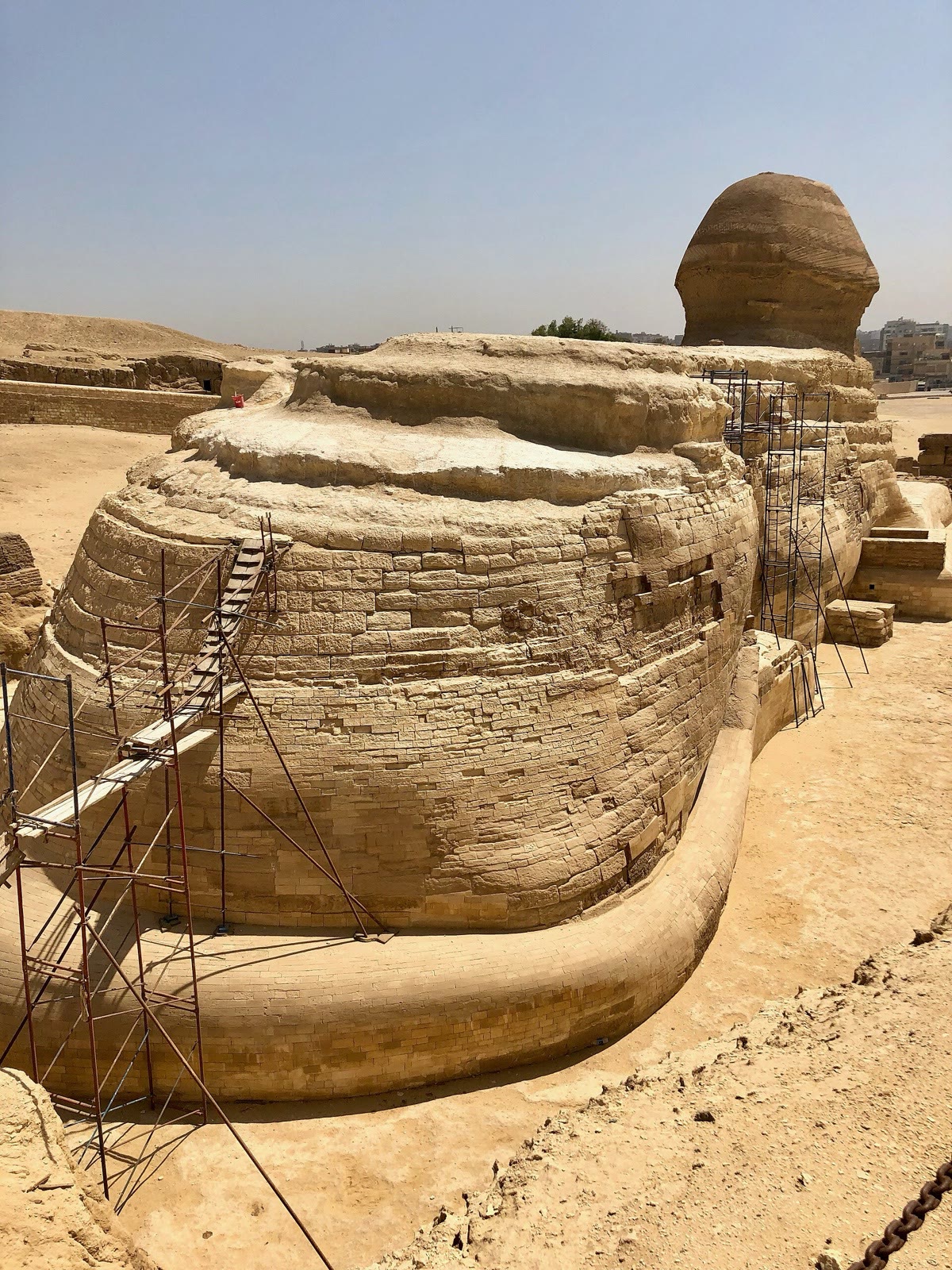
The Great Sphinx is simultaneously a carved geological mass, a monumental image and a component within a larger architectural setting. From far away, its body can disappear beneath the dominance of the head and nearby pyramid. At closer range, weathered limestone layers, restoration and enclosure become visible.
Describe what is carved from bedrock, what appears added or repaired, and which direction the figure faces. Then compare that description with current site interpretation.
Question the photograph you came to make
Telephoto compression can place pyramids into relationships that the walking body experiences differently. A wide panorama may make visitors disappear and distances look easy. The classic framed view is not dishonest, but it is a selection. Take one establishing image if permitted, then put the camera down and track how long the horizon, wind and ground take to cross.
Keep people outside your composition unless they have consented or remain incidental in a broad scene. Do not climb, touch or leave the marked route for a cleaner angle. The site’s current rules and conservation controls are part of responsible seeing.
End with a relationship, not a fact
Before leaving, name one relationship you could not see in the famous silhouette: temple to pyramid, tomb field to royal complex, bedrock to masonry, or ancient plateau to modern city. That relationship is a stronger field note than a list of dimensions memorised without place.
Next field noteSaqqara & Dahshur: experiment remains visible→