- Home
- Field notes
- Saqqara & Dahshur
Field note 02 · reviewed 10 August 2026
Experiment remains visible.
Saqqara and Dahshur make architectural change tangible: stacked form, enclosed courts, shifting angles and surviving casing. Compare carefully, but do not turn ancient decisions into a cartoon of failures before success.
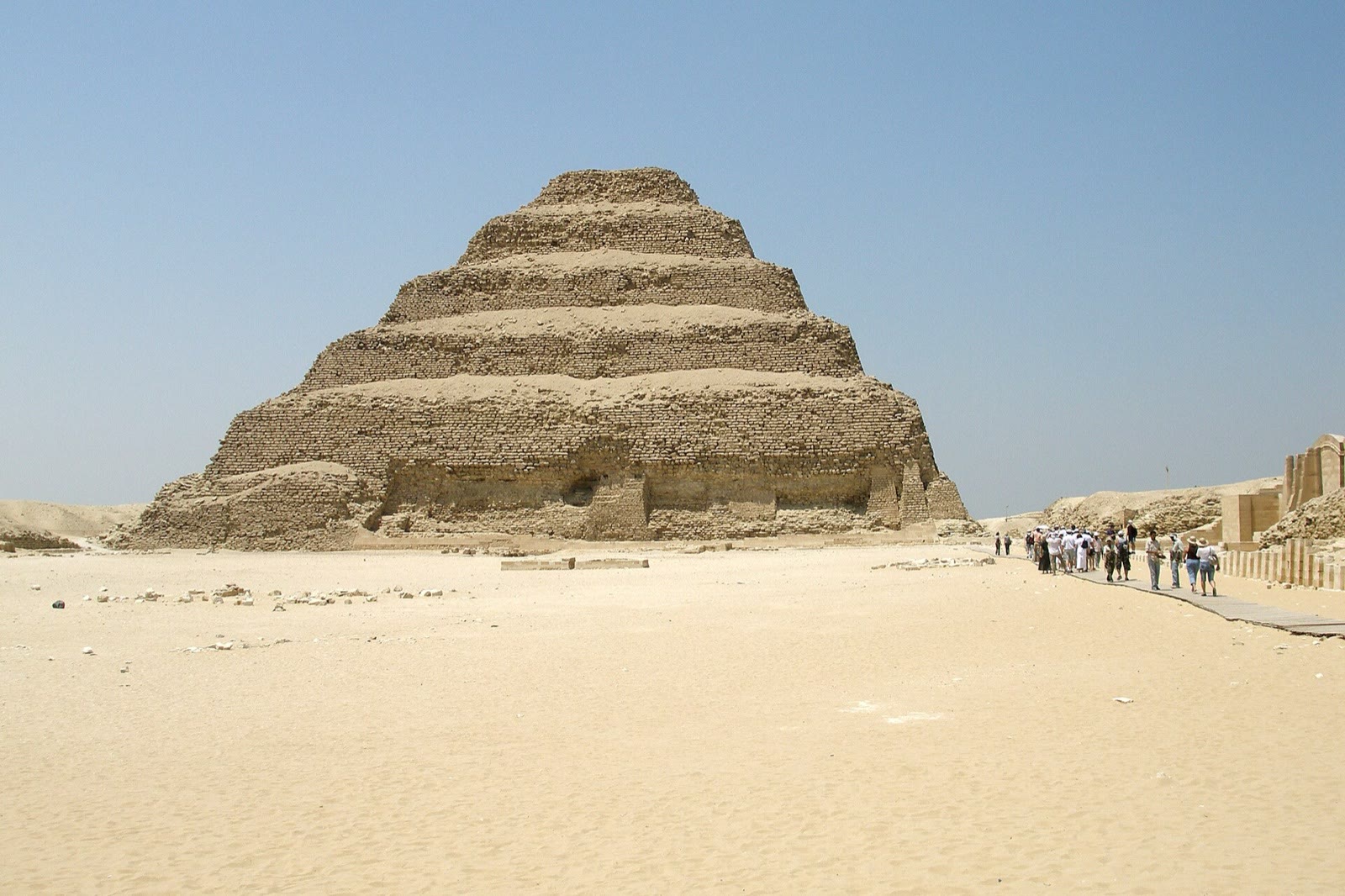
Early pyramid building is often presented as a straight ladder from small mastaba to perfect pyramid. The sequence is useful and too neat. Monuments changed through decisions about material, structure, ritual space and royal representation. Some forms were modified during construction; others were reused or altered later. The surviving building is evidence, not a diagram with one correct answer.
At Saqqara, look beyond the steps
Djoser’s Step Pyramid is visually immediate: stacked stages rise where a lower rectangular form might be expected. Yet the wider complex is essential. Enclosure walls, courts, gateways and symbolic buildings organised movement and royal ritual. Stone was used to reproduce or reinterpret forms associated with other materials, so details can resemble bundled reeds, timber or temporary architecture even when carved from limestone.
Choose one repeated form—column, doorway, false door or wall projection—and follow it through the accessible route. Ask whether it carries weight, directs movement or represents something rather than functioning in the way its appearance suggests. That distinction turns “the first stone building” slogan into observation.
At Dahshur, let angle become evidence
The Bent Pyramid changes angle partway up, making design adjustment visible in the final silhouette. The Red Pyramid presents a different profile. Together with other pyramid projects associated with Sneferu, they support questions about planning, structural behaviour and the development of smooth-sided monumental form.
Avoid calling the Bent Pyramid simply a mistake. The preserved monument, its unusual profile and surviving casing are more interesting than a verdict. Describe the lower and upper slopes, the transition between them and how light reveals the casing. Then use current archaeological interpretation to understand competing explanations.
| Feature | Saqqara question | Dahshur question |
|---|---|---|
| Silhouette | How do stacked stages produce height? | How does a change of angle alter the whole form? |
| Surface | Where is core, facing or restoration visible? | Where does casing survive and catch light? |
| Complex | How do courts and enclosure organise ritual? | How do approach and associated structures relate? |
| Material idea | Which non-stone forms are translated into stone? | Which structural decisions remain readable? |
Do not make chronology a race
A visitor can be tempted to announce that one monument “leads to” the next and then move on. Chronology is more useful when it produces a precise comparison. Which feature changes? What remains? What is known from archaeology rather than assumed from appearance? One carefully examined doorway or casing surface can support more history than three distant silhouettes collected in a morning.
Use “appears,” “survives,” “was modified” and “is interpreted as” when the evidence does not justify a simple intention.
Protect the sites from the itinerary
These desert-edge landscapes involve exposure, uneven ground and transport between separate areas. Current opening, interior access, ticketing and photography rules may differ by monument. Confirm them with the official monuments portal and an authorised local provider where transport or guiding is needed.
Do not climb, touch casing, enter closed zones or remove stone fragments. A low wall or scattered block is still archaeological material. Keep water and sun protection according to site rules, and place a genuine recovery period before attention collapses.
Record distance as part of the form
A photograph can make separate monuments appear like neighbouring exhibits. Note how long the road, walk and horizon take between views. At Saqqara, the larger necropolis extends far beyond the Step Pyramid complex. At Dahshur, open ground changes how a pyramid meets the sky. Distance helps explain why the same geometric form can feel dominant, remote or connected to other structures.
Mark the direction of cultivated land, modern settlement and other monuments without assuming that the present road reproduces an ancient route. The field note should preserve what the body learned between the photographs.
Make a three-form sketch
At the end, draw three simple outlines from memory: stepped, bent and straight-sided. Under each, write one material or spatial observation rather than a date. The sketch is not art and the sequence is not complete. It records what architectural change looked like to the body on site.
Next field noteHistoric Cairo: a gate is also a street lesson→