- Home
- Field notes
- Historic Cairo
Field note 03 · reviewed 10 August 2026
A gate is also a street lesson.
Bab Zuweila can be read as architecture, threshold, instrument of authority and anchor for continuing commerce. One gate opens a method for looking at a district that is historic because it has changed, not because time stopped.
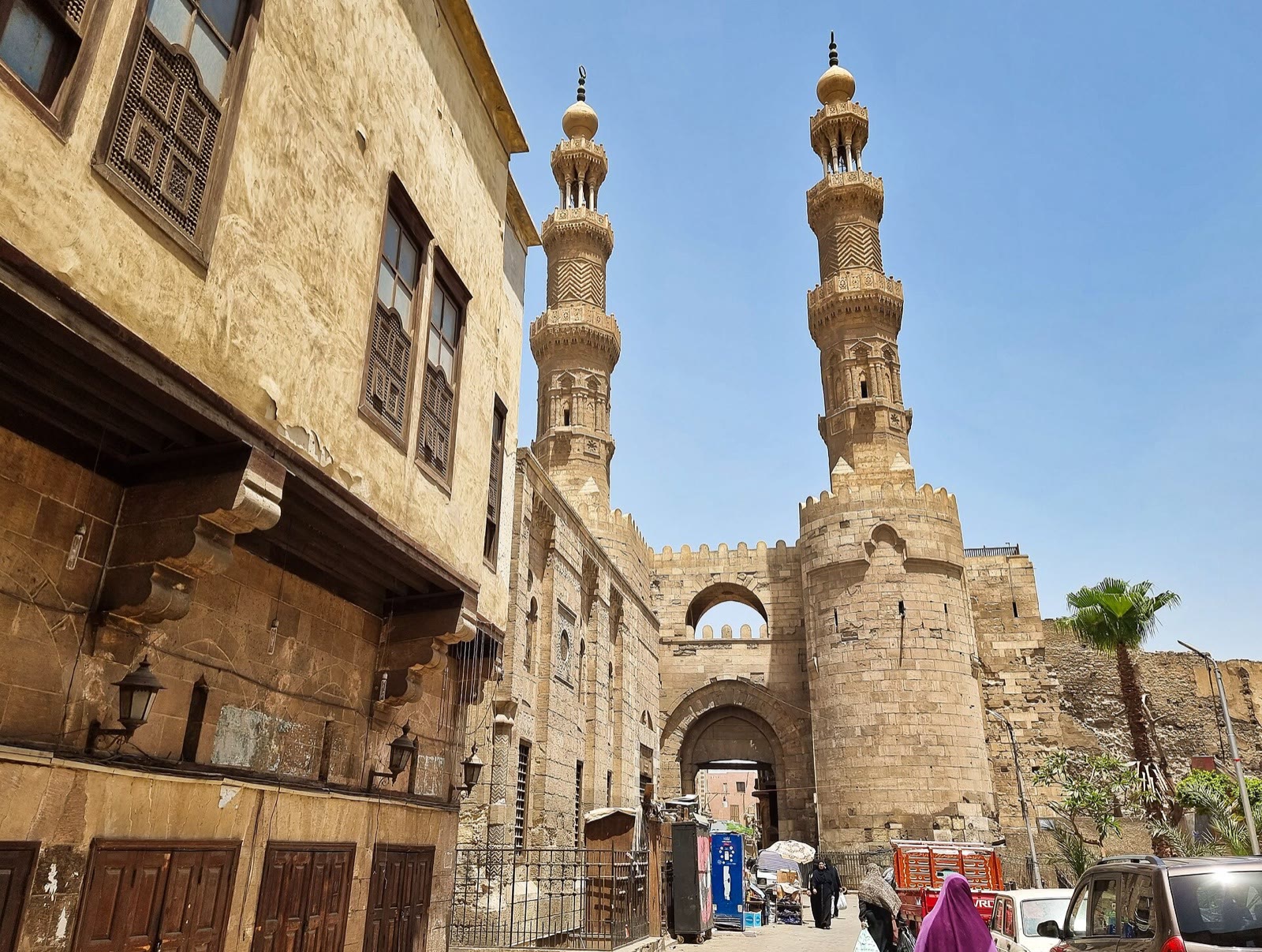
Historic Cairo is not one period and Bab Zuweila is not one date. The gate belonged to a medieval defensive boundary; the minarets above it came later; streets and trades around it continued to change. The resulting view is layered rather than impure. Begin by identifying which parts appear to belong to different building campaigns and uses.
Stand on both sides of the threshold
A gate creates direction. From one side it marks arrival; from the other it frames departure. It narrows movement, controls passage and makes authority visible. Look at the depth of the opening, the relationship between towers and passage, and the way the adjoining street approaches. Modern traffic, shop display and pedestrian movement reveal that the threshold still affects the street even when the old wall no longer controls a city edge.
Do not remain in the centre of the passage to make a symmetrical photograph. Step aside, watch who needs the space and let function correct the architectural composition.
Separate gate, minaret and skyline
The paired minarets associated with the Mosque of al‑Mu’ayyad rise above the gate and reshape its profile. Their position demonstrates how later religious architecture could use an existing monumental structure and urban landmark. From ground level, ask which elements carry weight, which frame the street and which announce presence at a distance.
If an upper route is officially open, the changing view can make the medieval city’s density easier to read. Access, stairs and safety conditions must be checked on the day. A rooftop photograph is not worth entering a closed area or pressuring staff for an exception.
Let the street continue the monument
South and nearby, the Street of the Tentmakers is associated with khayamiya textile work. The craft has its own history, labour and changing market rather than serving as decorative atmosphere for the gate. Notice shop scale, hanging display, handwork and the interaction between customer and maker. Ask permission before photographing a person or close work process.
| Layer | Visible clue | Responsible action |
|---|---|---|
| Fortification | Gate mass, passage and former boundary | Keep circulation clear |
| Religious architecture | Minarets, mosque relationship and soundscape | Respect worship and posted rules |
| Commercial street | Shopfront, display, delivery and negotiation | Ask before photographing people or work |
| Conservation | Repair, cleaned stone and controlled access | Do not touch or cross barriers |
Read repair as part of the record
Historic masonry is rarely a single untouched surface. Darkened stone, replacement blocks, patched joints and restored architectural details can indicate weathering, intervention and changing conservation practice. Describe differences without assuming that older always means darker or rougher. A restoration may preserve structure while also changing what the eye notices.
Which material belongs to which phase, and what problem was a later intervention trying to solve?
Keep daily life out of the background
Residents and workers are not scale figures for heritage photography. Avoid blocking a doorway, directing a vendor into a pose, photographing children without a guardian’s clear permission or treating worship as spectacle. A public street still contains private moments.
Transactions deserve clarity. If you want an object or service, ask about material, process and price before accepting it. If you do not, decline without mockery. The district does not owe every visitor a conflict-free performance.
Listen for boundaries the eye misses
Sound reveals changes in use: traffic compresses at a gateway, metalwork or textile activity occupies a commercial stretch, and a call to prayer reorganises attention around religious space. Record the change without making people’s work or worship into entertainment. Smell and temperature can also mark the move from open street to covered passage or interior.
These observations are temporary. Write the time and conditions rather than claiming a permanent character for the district. A quiet morning and a busy evening are different evidence.
Walk one short sequence twice
On the first pass, record architecture: threshold, facade, roofline and material. On the return, record activity: movement, sound, shade and use. The two notes will not align perfectly. That mismatch is the point. Historic Cairo is legible as an inhabited urban fabric, not a row of isolated monuments.
Next field noteThe southern Nile: temples are sequences, not façades→